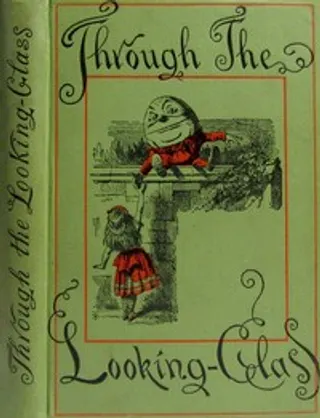
Carroll frames the whole book as a game of chess, with Alice as a white pawn working her way to the eighth square and a crown, laid out move by move before the story even starts. The dedication poem that follows, about children who "fret to find our bedtime near," makes plain this was written to be read at exactly that hour.
About this book
First published 1871 · Sequel to Alice's Adventures in Wonderland · Source of the poem Jabberwocky · Never out of print
Six years after Alice's Adventures in Wonderland, Lewis Carroll, who was the Oxford mathematician Charles Dodgson, sent Alice back into a stranger world, this one laid out as a game of chess played behind a mirror. The idea of the looking-glass, so the story goes, came from a young relation also named Alice, Alice Raikes, whom he stood before a glass and asked which hand her reflection held an orange in. He published the book, illustrated again by John Tenniel, in 1871.
It was as successful as the first Alice and is often read as one book with it. Where Wonderland gave us the Mad Hatter, the looking-glass world gave us Tweedledum and Tweedledee, Humpty Dumpty, the White Knight and the poem 'Jabberwocky', whose invented words chortle and galumph went into ordinary English and stayed there. It has never been out of print.
The copy on this shelf is the full original text.
Chapters
A long one: read it a chapter a night.
- CHAPTER I. Looking-Glass house
- CHAPTER II. The Garden of Live Flowers
- CHAPTER III. Looking-Glass Insects
- CHAPTER IV. Tweedledum And Tweedledee
- CHAPTER V. Wool and Water
- CHAPTER VI. Humpty Dumpty
- CHAPTER VII. The Lion and the Unicorn
- CHAPTER VIII. “It’s my own Invention”
- CHAPTER IX. Queen Alice
- CHAPTER XII. Which Dreamed it?
Public domain. Source text via Project Gutenberg, PG boilerplate removed. View the source edition