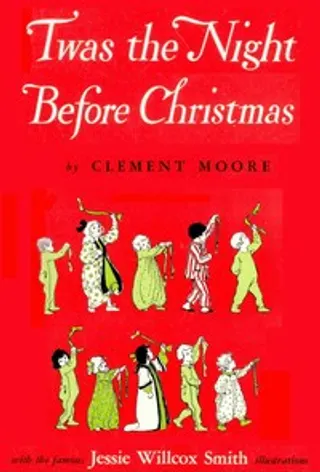
About this book
First published 1823 · Printed anonymously at first · Shaped the modern Santa Claus
The verses first appeared anonymously in the Troy Sentinel, a small New York newspaper, on 23 December 1823, sent in by a friend of the writer. Clement Clarke Moore, a scholar of Hebrew and Greek literature, later said he had written them for his own children the Christmas before, and he put his name to the poem when he collected his work in 1844. Some scholars have since argued that the real author was another New York writer, Henry Livingston Jr., and the question has never been fully settled.
The poem did more than anything before it to shape the modern picture of Santa Claus. It named the eight reindeer, sent him down the chimney, and gave him the round belly that shook like a bowl full of jelly. Later illustrators, Thomas Nast chief among them, drew their pictures straight from its lines.
The copy on this shelf is the full poem in an illustrated Project Gutenberg edition.
A word before the story
A Visit from St. Nicholas
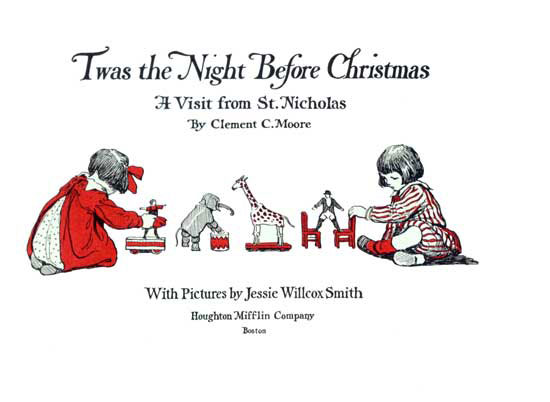
By Clement C. Moore
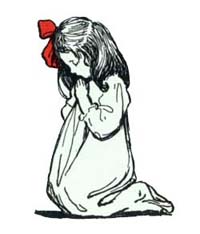
With Pictures by Jessie Willcox Smith

Houghton Mifflin Company

Boston
Copyright (c) 1912 by Houghton Mifflin Company

All rights reserved. For information about permission
to reproduce selections from this book, write to
Permissions, Houghton Mifflin Company, 215 Park
Avenue South, New York, New York 10003.
HC ISBN 0-395-06952-1
PA ISBN 0-395-64374-0

Printed in the United States of America
LBM 40 39 38 37 36
INTRODUCTION
Amid the many celebrations last Christmas Eve, in various places by
different persons, there was one, in New York City, not like any other
anywhere. A company of men, women, and children went together just after
the evening service in their church, and, standing around the tomb of
the author of “A Visit from St. Nicholas,” recited together the words of
the poem which we all know so well and love so dearly.
Dr. Clement C. Moore, who wrote the poem, never expected that he would
be remembered by it. If he expected to be famous at all as a writer, he
thought it would be because of the Hebrew Dictionary that he wrote.
He was born in a house near Chelsea Square, New York City, in 1781; and
he lived there all his life. It was a great big house, with fireplaces
in it;--just the house to be living in on Christmas Eve.

Dr. Moore had children. He liked writing poetry for them even more than
he liked writing a Hebrew Dictionary. He wrote a whole book of poems for
them.
One year he wrote this poem, which we usually call “’Twas the Night
before Christmas,” to give to his children for a Christmas present. They
read it just after they had hung up their stockings before one of the
big fireplaces in their house. Afterward, they learned it, and sometimes
recited it, just as other children learn it and recite it now.

It was printed in a newspaper. Then a magazine printed it, and after a
time it was printed in the school readers. Later it was printed by
itself, with pictures. Then it was translated into German, French, and
many other languages. It was even made into “Braille”; which is the
raised printing that blind children read with their fingers. But never
has it been given to us in so attractive a form as in this book. It has
happened that almost all the children in the world know this poem. How
few of them know any Hebrew!

Every Christmas Eve the young men studying to be ministers at the
General Theological Seminary, New York City, put a holly wreath around
Dr. Moore’s picture, which is on the wall of their dining-room. Why?
Because he gave the ground on which the General Theological Seminary
stands? Because he wrote a Hebrew Dictionary? No. They do it because he
was the author of “A Visit from St. Nicholas.”
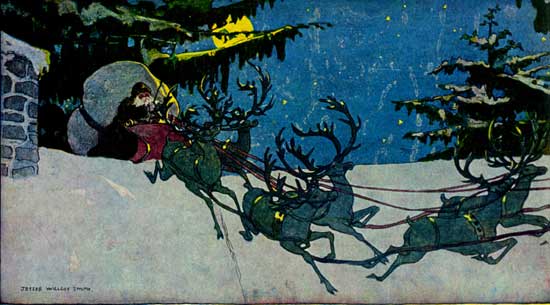
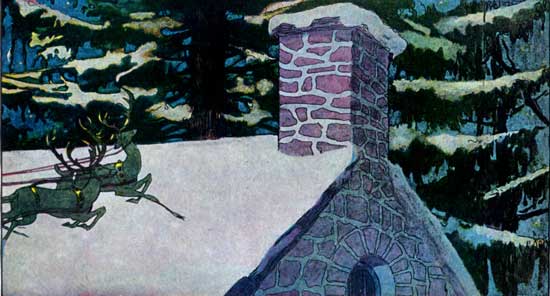
Most of the children probably know the words of the poem. They are old.
But the pictures that Miss Jessie Willcox Smith has painted for this
edition of it are new. All the children, probably, have seen other
pictures painted by Miss Smith, showing children at other seasons of the
year. How much they will enjoy looking at these pictures, showing
children on that night that all children like best,--Christmas Eve!
E. McC.
’Twas the Night before Christmas

’Twas the night before Christmas, when all through the house
Not a creature was stirring, not even a mouse;
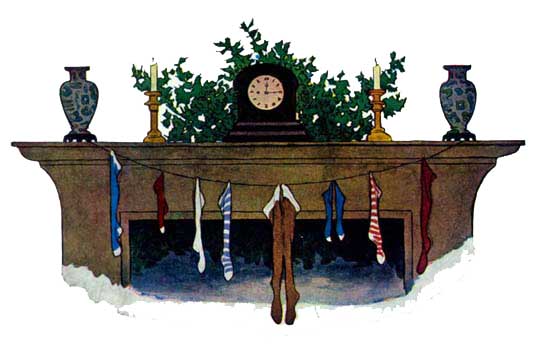
The stockings were hung by the chimney with care
In hopes that St. Nicholas soon would be there;

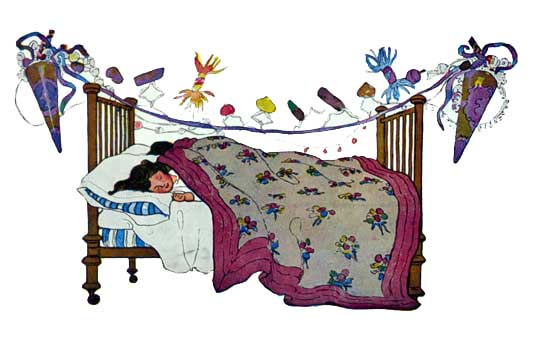
The children were nestled all snug in their beds,
While visions of sugar-plums danced in their heads;
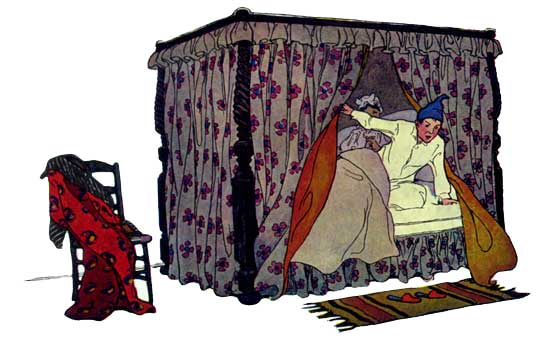
And mamma in her kerchief, and I in my cap,
Had just settled our brains for a long winter’s nap,

When out on the lawn there arose such a clatter,
I sprang from the bed to see what was the matter.
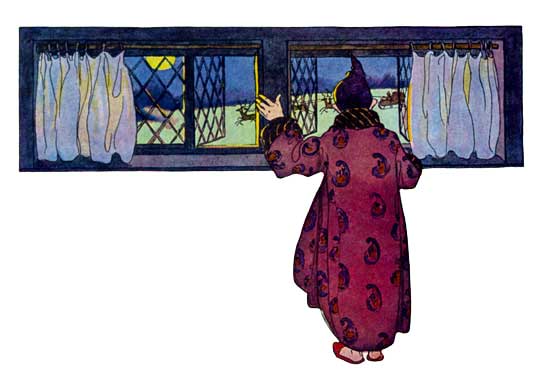
Away to the window I flew like a flash,
Tore open the shutters and threw up the sash.

The moon on the breast of the new-fallen snow
Gave the lustre of mid-day to objects below,
When, what to my wondering eyes should appear,
But a miniature sleigh, and eight tiny reindeer,

With a little old driver, so lively and quick,
I knew in a moment it must be St. Nick.
More rapid than eagles his coursers they came,
And he whistled, and shouted, and called them by name:
“Now, Dasher! now, Dancer! now, Prancer and Vixen!
On, Comet! on, Cupid! on, Donder and Blitzen!
To the top of the porch! to the top of the wall!
Now dash away! dash away! dash away all!”

As dry leaves that before the wild hurricane fly,
When they meet with an obstacle, mount to the sky;
So up to the house-top the coursers they flew,
With the sleigh full of Toys, and St. Nicholas too.
And then, in a twinkling, I heard on the roof
The prancing and pawing of each little hoof.
As I drew in my head, and was turning around,
Down the chimney St. Nicholas came with a bound.

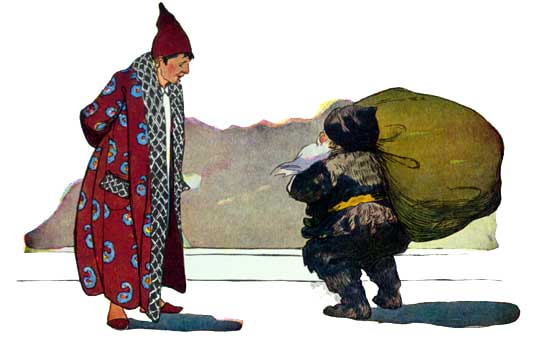
He was dressed all in fur, from his head to his foot,
And his clothes were all tarnished with ashes and soot;
A bundle of Toys he had flung on his back,
And he looked like a peddler just opening his pack.
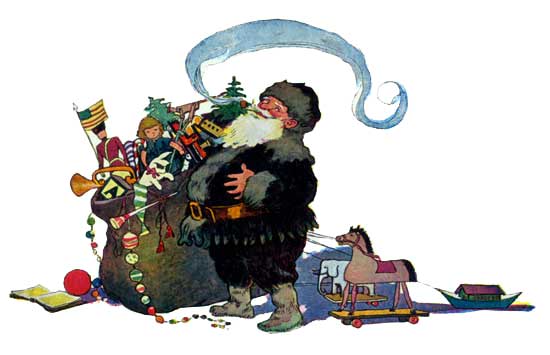
His eyes--how they twinkled! his dimples how merry!
His cheeks were like roses, his nose like a cherry!
His droll little mouth was drawn up like a bow,
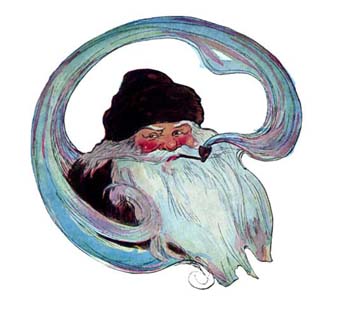
And the beard of his chin was as white as the snow;

The stump of a pipe he held tight in his teeth,
And the smoke it encircled his head like a wreath;
He had a broad face and a little round belly,
That shook when he laughed, like a bowlful of jelly.
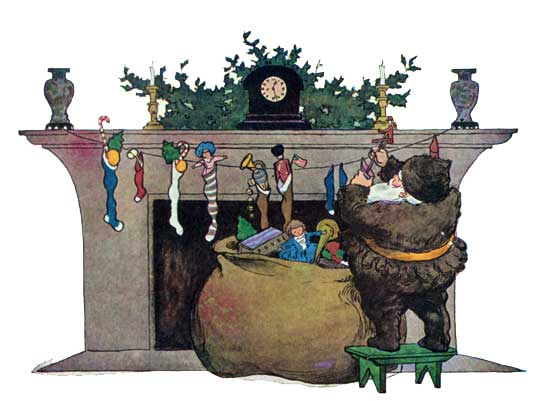
He was chubby and plump, a right jolly old elf,
And I laughed when I saw him, in spite of myself;
A wink of his eye and a twist of his head,
Soon gave me to know I had nothing to dread;
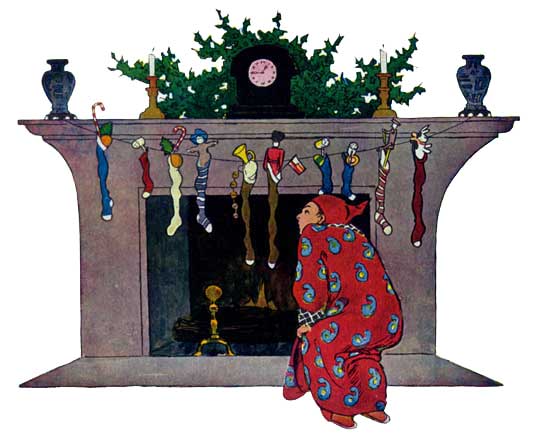
He spoke not a word, but went straight to his work,
And filled all the stockings; then turned with a jerk,
And laying his finger aside of his nose,
And giving a nod, up the chimney he rose;
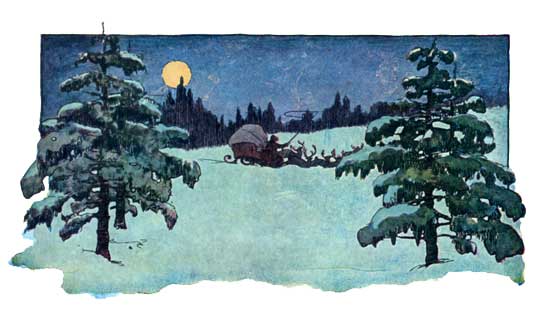
He sprang to his sleigh, to his team gave a whistle,
And away they all flew like the down of a thistle.
But I heard him exclaim, ere he drove out of sight,
“Happy Christmas to all, and to all a good-night.”
Public domain. Source text via Project Gutenberg, PG boilerplate removed. View the source edition