Nonsense Songs, Stories, Botany and Alphabets · Edward Lear
Chapter VII.
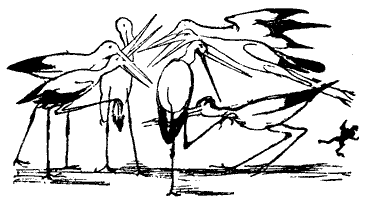
THE HISTORY OF THE SEVEN YOUNG GEESE.
When the seven young Geese began to travel, they went over a large plain,
on which there was but one tree, and that was, a very bad one.
So four of them went up to the top of it, and looked about them; while the
other three waddled up and down, and repeated poetry, and their last six
lessons in arithmetic, geography, and cookery.
Presently they perceived, a long way off, an object of the most interesting
and obese appearance, having a perfectly round body exactly resembling a
boiled plum-pudding, with two little wings, and a beak, and three feathers
growing out of his head, and only one leg.
So, after a time, all the seven young Geese said to each other, "Beyond all
doubt this beast must be a Plum-pudding Flea!"
On which they incautiously began to sing aloud,
"Plum-pudding Flea,
Plum-pudding Flea,
Wherever you be,
Oh! come to our tree,
And listen, oh! listen, oh! listen to me!"
And no sooner had they sung this verse than the Plum-pudding Flea began to
hop and skip on his one leg with the most dreadful velocity, and came
straight to the tree, where he stopped, and looked about him in a vacant
and voluminous manner.
On which the seven young Geese were greatly alarmed, and all of a
tremble-bemble: so one of them put out his long neck, and just touched him
with the tip of his bill; but no sooner had he done this than the
Plum-pudding Flea skipped and hopped about more and more, and higher and
higher; after which he opened his mouth, and, to the great surprise and
indignation of the seven Geese, began to bark so loudly and furiously and
terribly, that they were totally unable to bear the noise; and by degrees
every one of them suddenly tumbled down quite dead.
So that was the end of the seven young Geese.
CHAPTER VIII.
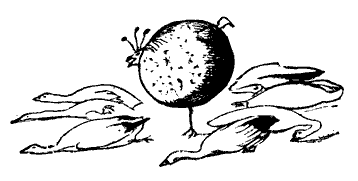
THE HISTORY OF THE SEVEN YOUNG OWLS.
When the seven young Owls set out, they sate every now and then on the
branches of old trees, and never went far at one time.
And one night, when it was quite dark, they thought they heard a mouse;
but, as the gas-lamps were not lighted, they could not see him.
So they called out, "Is that a mouse?"
On which a mouse answered, "Squeaky-peeky-weeky! yes, it is!"
And immediately all the young Owls threw themselves off the tree, meaning
to alight on the ground; but they did not perceive that there was a large
well below them, into which they all fell superficially, and were every one
of them drowned in less than half a minute.
So that was the end of the seven young Owls.
CHAPTER IX.
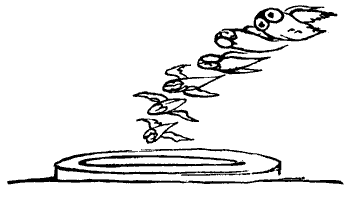
THE HISTORY OF THE SEVEN YOUNG GUINEA PIGS.
The seven young Guinea Pigs went into a garden full of goose-berry-bushes
and tiggory-trees, under one of which they fell asleep. When they awoke,
they saw a large lettuce, which had grown out of the ground while they had
been sleeping, and which had an immense number of green leaves. At which
they all exclaimed,--
"Lettuce! O lettuce
Let us, O let us,
O lettuce-leaves,
O let us leave this tree, and eat
Lettuce, O let us, lettuce-leaves!"
And instantly the seven young Guinea Pigs rushed with such extreme force
against the lettuce-plant, and hit their heads so vividly against its
stalk, that the concussion brought on directly an incipient transitional
inflammation of their noses, which grew worse and worse and worse and
worse, till it incidentally killed them all seven.
And that was the end of the seven young Guinea Pigs.
Public domain. Source text via Project Gutenberg, PG boilerplate removed. View the source edition